

[Excerpt] - Whispers in the Cemetery (TCoM)
Another excerpt from The Call of Mammitum - Chapter 4

First, the obligatory, Folk Metal soundtrack (Lyrics by Justin Zimmer, music by Suno.com — Full Playlist):
Whispers in the Cemetery (TCoM Ch. 4)
The last bell rings, and I slip out the back to the service road—past the yard, across the back field.
The Sun presses hot on my back; sweat pools under my shirt. It was cold this morning, but now my jacket feels stupid, trapped in my elbow crook as I tug my collar open—and my books slip. I fumble. “Clumsy,” I huff.
The back road spits me onto Market Street, and Kerr Hill’s wrought-iron fence runs beside the sidewalk like a cage. Near Main, the library’s corner edges into view—gray stone, watching—and I can’t help looking. A black Ford chugs past, kicking up dust; motor fumes bite my nose as it swings down Main, where other cars sit slanted at the storefronts. A man races by on a bicycle.
Wheels everywhere—tires, spokes, pedals—but no wheelchair. I should be relieved. I’m not. I don’t want to see him—
Oh. But I would have liked to.
All day, I dodged Tommy—skipped lunch, hid in the typewriting room, tapped nonsense on the keys and told myself it was practice.
Something tugs low in my stomach, and I clamp my books against it. It’s not hunger—that’s a higher ache, cold under my ribs. This is different. This feels like forgetting, like reaching into a pocket that shouldn’t be empty. I always forget things—sometimes even the shape of what I forgot—but today I know exactly what’s missing.
My chest pulls tight like a fist—every rib a finger, every breath a strain, every heartbeat a spasm. It’s like this every day after school, and usually the walk helps. Not today. The clutch cinches tighter, so I turn through the gates of Kerr Hill Cemetery. I don’t need a walk. I need someone to listen.
Grit grinds underfoot on the cobbles as I follow the footpath up and around the hill. Empty plots stagger between freshly hewn tombstones. Overhead, the long yellow strands of a changing willow sway and swish; leaves like golden blades spin around me, and wind slips through—hissing, sighing—like words I can’t understand, as if whispering secrets only the dead should know.
Daylight’s already thinning through the trees where Kerr Hill meets the western range; the Sun follows the gone Moon, and shadows stretch off every stone.
I’m glad for my jacket now. In the shade, the wind finds the sweat at my neck and chills it; a shiver climbs over my back.
But I’m not afraid—not here. My lungs loosen. The quiet sits soft around me. Mourners keep to themselves, and the dead don’t judge.
I follow the path to the cenotaph the town put up a year after the war ended: a granite wall taller than me, long and lined with small bronze plaques etched with the names of the bodiless dead—soldiers buried far from home, townfolk lost at sea.
I stop at two near the edge, side by side.
Matthew M. Albright Husband and Father 1879–1916
Pvt. Marcus M. Albright Brother and Son 1899–1918
That’s it: names and titles. Nothing else.
Papa—his laugh filling every room, his smile catching and spreading like flame—telling me how the calm sea at night turns to stars, like being wrapped up in heaven.
And Marcus—ruffling my hair, telling me not to worry so much—standing in Papa’s place when he was gone, knowing every secret I ever had. My best and only friend.
Now they’re just names on metal plates—my heart reduced and pinned to a wall.
I kneel, tuck my ankles under, and set the books down beside me. Closing my eyes, I draw my jagged thumbnail across the skin beneath my palm: sharp, hot, then cool.
Again, and again—until my chest loosens, until my jaw lets go.
I whisper, “Hey Papa. Hey Marcus. It’s been a strange day. We’ve got a new teacher—Dr. Gewargis. He’s different; strict, but clever. Or he thinks so. We talked about that old library fire—the one from a hundred years ago.”
Marcus’s voice cuts in, clear as ever: Oh, that, Mattie? Just old wives’ tales.
My cheeks lighten. He’s on my left, where Sun leaks through the willows—but I don’t dare look. If I look, he might vanish. This isn’t a dream; it’s my imagination, and I cling to it. This is why I come: I need it. I can’t talk to anyone else, so why not them?
“I never thought much about it before,” I whisper. “But the way Tommy talked… it sounded interesting.”
Heat rushes my cheeks. Marcus’s eyebrow goes up. A boy, Mattie?
I sigh. “It’s not like that.”
Tommy Sinclair is just a boy from school—a boy who asked me, of all people, to study with him. But when he talked to me… I didn’t feel silly. I felt safe. Not the weird girl. Not the stupid girl.
Of course not, Pa’s voice chimes in from the right. Mattie’s too young for that.
I picture him there and my little smile grows—his broad grin, the crinkle at the corners of his eyes. I’m fifteen, but when I think of him, I’m still that girl in pigtails watching the sea and waiting.
“Tommy did ask me to meet at the library—to study for our History paper.”
My cheeks draw heavy. Sting—hard and fast—and heat spills over my eyes. I swipe with my palm.
“Oh! Papa, but I told him I couldn’t. I got scared. I don’t even know why. He’s so kind. Everybody likes him, and he’s smart—so smart.”
I shake my head.
“Why would he want to talk to me at all?”
The lift in my mouth collapses, and my throat goes tight.
“I—I need h-his help. That p-paper’s our w-whole grade. And I c-can’t d-do it alone.” My breath catches. “Mama wants me to do well, but all I ever do is disap—point her. I’m ruining the plan, Papa. She’s killing herself, and I just can’t do it.”
My nail finds the soft skin at my wrist—back and forth, back and forth—hot, hot, sharp, sharper. I roll up my sleeve. Red wells.
I smear it on my pants, cross my legs, and stare at the new line: wet red shining between today’s welts. It’ll scar white—like the older ones.
“It’s so hard here without you,” I whisper. “I wish you were both still here.”
My hands blot out the light, damp in my tears.
“Marcus, Mama would be so proud of you.”
A sniff yanks in hard, shuddering my chest.
“And Papa, if you were here, maybe she’d laugh again—the way she used to laugh at your awful fish jokes.”
I let my hands fall. Their plaques stare back, greening at the edges
“You could both help with Aunt Millie… She almost didn’t know me today. What’ll we do when she doesn’t remember me at all?”
I grip my knees tight.
“It feels like we’re walking a tightrope… and the rope’s starting to tear. I can feel it fraying underfoot—strand by strand. And when it snaps…” My voice shrinks. “…there’s nothing underneath.”
Head up, I shut my eyes.
“I keep thinking there’s something I’m supposed to do, but I don’t know what.”
My nails bite my palms and I glare at the names etched in front of me.
“If you were here, none of this would feel so hopeless. You’d know what to do. I don’t know if I can go on like this. Things would be better if you were here instead of—”
I swallow, and the words fall out.
“I wish… I wish I could trade places with you.”
They hang in the air a beat—then echo inside me, sharp as broken glass.
My chest aches, but I can’t take the words back. Because I do mean them.
The light blurs, and the wind sighs. I wait for their voices to scold me, comfort me, anything. But they don’t answer—they’re not listening. The cold sinks in.
My head shakes as I pull the green kerchief from my pocket, wipe my eyes, and blow my nose. Standing, I brush off the dirt and leaves; lift my books.
“Maaattie.”
A tingle shoots down my neck; every hair lifts. Did I really hear that?
The path. The shadows. The gaps between stones. No one’s there.
“Maaattie.”
Behind me—a voice, rasping as if woven from wind and leaves. I whip around.
A man in uniform stands down the path. Pale face—blurred. Marcus? He dissolves into shadow and he’s gone.
My skin prickles up my arms, down my legs. My stomach turns. I should run. Oh—run. But my legs drag like trudging wet sand as I step back, up the path.
It’s my imagination. It has to be. But it feels like a dream creeping up on me anyway. My name whispers again—right at my ear—and every hair on my body lifts. Papa’s voice, I think, my heart shaking, my belly gone cold. I turn, and he’s there down a branch in the path, draped in broken light: oilskin jacket, sou’wester hat dripping wet, face pale—almost white—hand lifted, waving me toward him.
Oh, Papa!
My feet drag me forward, but he’s gone at the first step. My breath catches. Was he really there? But I walk to where he stood, and their voices rise and fall—Papa, then Marcus—louder with every step, speaking my name, again and again. Then, a promise: You can see us again!
Oh—God—I want to. That want pulls me further. I don’t know what’s happening, but the voices tug me along anyway. Beneath them, a chorus of strange syllables bubbles up, whispers chanting—ki-gal-sheh, ki-gal-sheh
Soon I’m past the graves I know, and everything is strange. I’ve never been here. The cobbles give way to dirt; roots snake through the cracks and grass sprouts between. The stones are broken, names corroded, dates worn dull from before the Revolution—seventeen hundreds, sixteen hundreds.
The hills climb steep, and the sunlight dims to dusk through the thick branches. Something shifts ahead—shadow breaking from shadow.
“Papa? Marcus?” My voice cracks, thin and shaky in my chest.
The shifting dark pauses. Figures turn, and vanish. The whispers hush into soft syllables scraping across the ground.
A wooded hill climbs ahead. Rays of light break through the branches and over the ridge, barring a pit of shadow—and in that pit, half-swallowed by the hill, is a stone tomb. Massive. Dark. A mausoleum? A house for the dead?
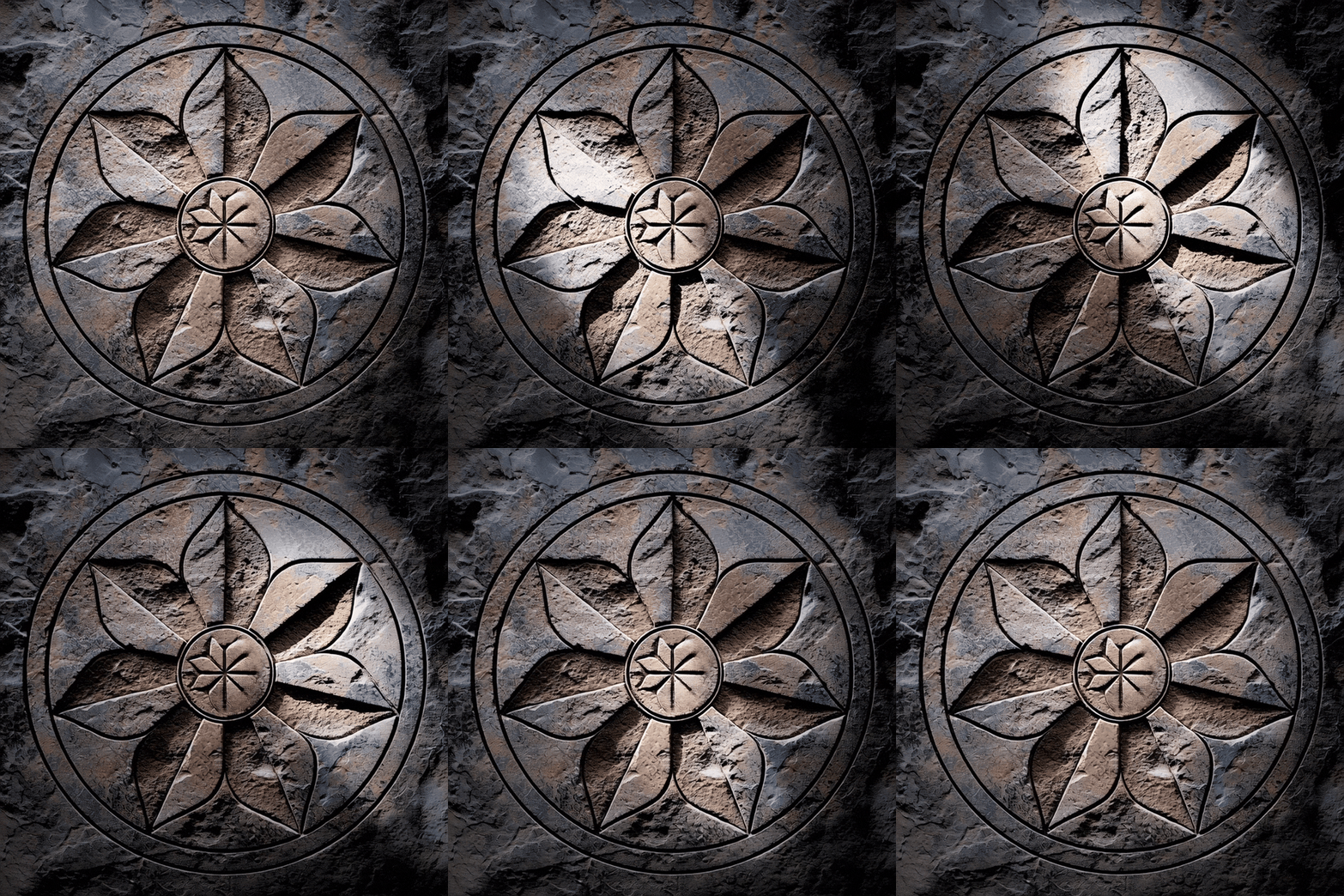
The stone door towers over me, wide as I am tall. At its center, there’s a carving: an encircled flower with seven petals, each curving to a point, and split along the vein. At the heart lies a symbol made of four wedge-shaped lines crossed like jackstraws.
My feet carry me forward, and the whispers rush in—across the weathered stones, through the willow boughs behind me. A dozen voices, a hundred, maybe a thousand, each repeating the same strange words. They flutter around me like moths, pulling, nudging, calling.
Ki-gal-sheh, ki-gal-sheh, ngesh-tug-zu ki-gal-sheh si.
The stone is warm and damp under my fingers, sweating like skin after a hot bath. I trace the flower, then place both hands on the door and feel a change.
The whispers swell until they fill me—lift me—push something loose in my chest, and it all comes rushing in: Mama’s wet glare shoving me out the door; waking in the classroom with every eye watching; Tommy’s face when I told him no; my broken dreams; the weight of my wish to join the dead.
I shut my eyes and my forehead touches the stone, and it grows warmer still. It hums like a question, and I sigh like an answer.
The stone turns to ice, and I stumble back—tears in my eyes again, hands trembling. My chest squeezes. I want to go home.
But the seven-petaled flower won’t let me. I want to—no, I have to—know what it means. I trace it again, but the shape slips the second I blink. I won’t remember it right. My knees hit the cold soil and I unstrap my books. I pull my pencil, then a folded sheet. On one side, Ganser and the Great war, crossed out—I stop.
Dr. Gewargis’ voice—find me something... interesting.
The light drops as the last spears of sunlight flicker out above and dusk takes the sky.
I shake my head and stand—dry the stone with my sleeve, press the page blank-side out, and rub. My hands shake; the page blurs, but I’ve got it: the flower’s echo.
The air turns bitter; my breath fogs. Darkness is settling in. I’m alone in the cemetery, and I no longer feel safe.
I tuck the rubbing into my jacket, bundle up my books and race back up the path. Ground and bramble blur together, and I flinch at every snap of a branch as I stumble through shadows across the stony fields of the dead.
Owls hoot in the willows, and nighthawks beat invisible-wings above. I duck my head and run faster.
Electric globes burn on bronze posts ahead—yellow and steady. I’m panting, chest shuddering, but that yellow light soothes me.
I want to go home—to the warm stove, to whatever meal Mama made—but the glow of the library windows catches me at the gate, and I stop.
The sky glows dusky purple. I check Papa’s watch—less than two hours before Mama needs me. The rubbing shifts in my pocket, rustling like a thought I can’t quiet, refusing to be forgotten even as my stomach growls.
My thoughts run in circles—what just happened? What was that? Who can I tell?
Who would believe me?
I know who. I rejected him—lied to him. Still… he’ll be there. He said so. And I believe him.
I leave the cemetery. The library rises ahead. But I carry those whispers with me—ki-gal-sheh, ki-gal-sheh—as I run to Tommy Sinclair.