


I'm the last person anybody should ask about well being, but I’ve spent a fair amount of time noodling over spirituality, and I love tearing apart ideas. So here are my thoughts on the spat between Todd Kashdan , Joep van Agteren and Christian Waugh
But, first, let's make sure we've got a good definition of the word spiritual. OED, take it away!
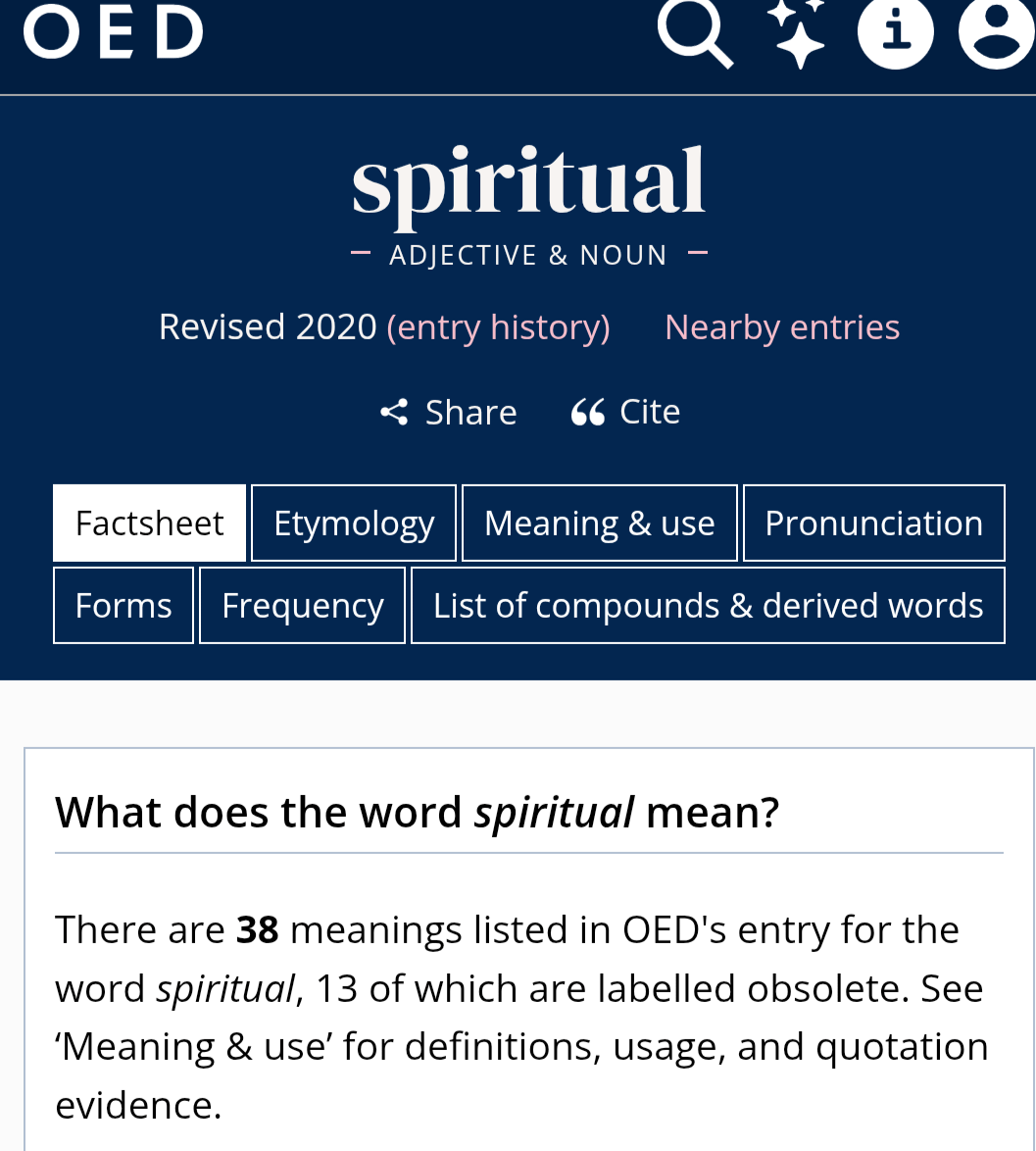
Maybe not. Okay, Merriam-Webster it is (taking the top):
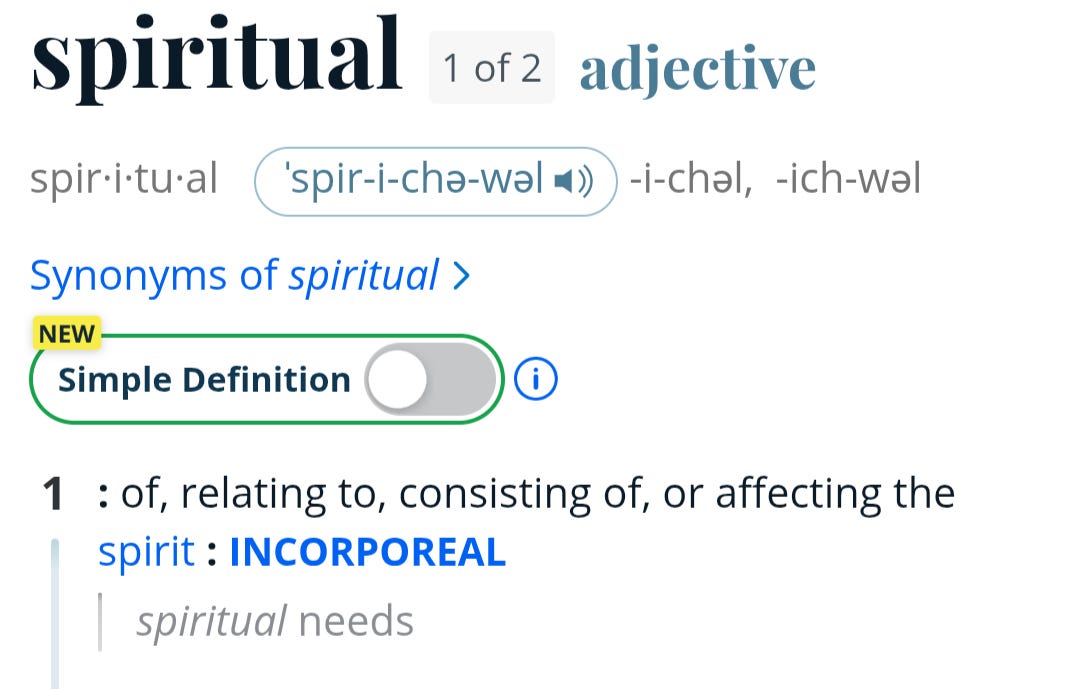
🙄 One more:
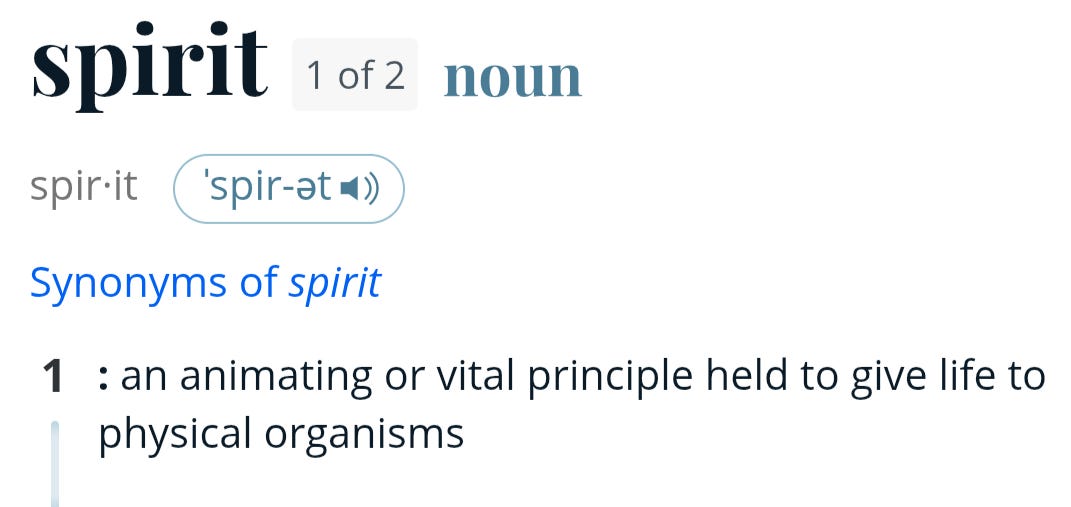
Okay, that's pretty generic. From the Latin spiritus meaning breath, air, soul etc, the lack of which indicates the opposite of life and we're natural essentialists so it follows we'd get all wooey about outgassing.
But of course that just isn't sexy enough, and to the point we'll include this one:
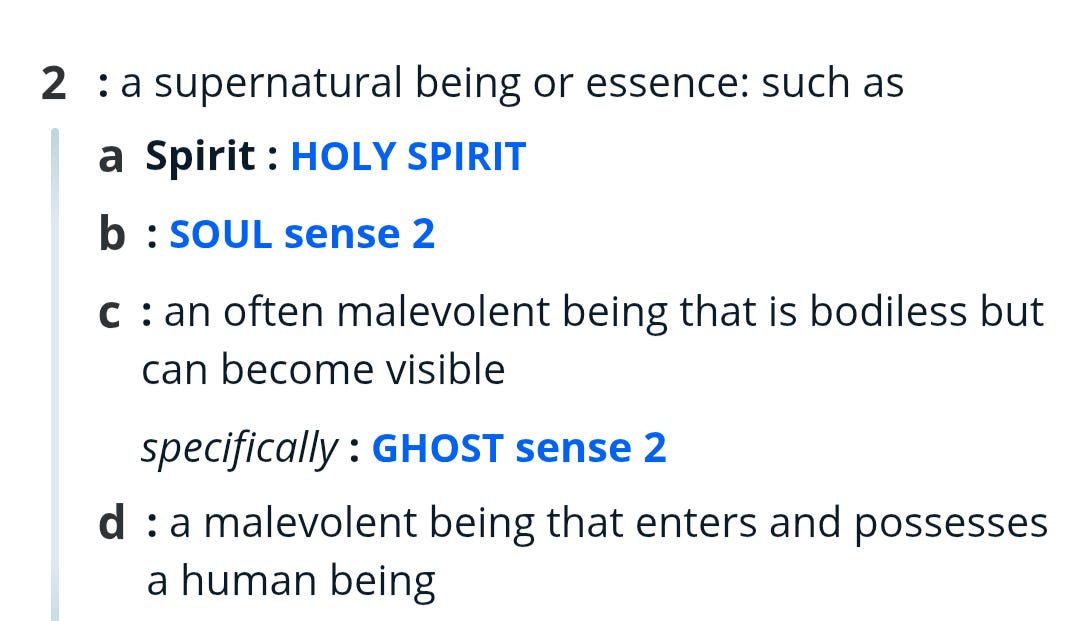
Because once you've established lung-wind as the essence of life, you can extend that to any such phenomenon in the natural world and the make-believe begins. Unseen things and causes become entities. Next thing you know you're saying magic words over crackers to turn them into god meat (humans are weird).
But I digress.
I picked these two definitions because when Pew takes a poll, they may get good data, but usually ask bad questions. The gist: lots of people believe in unseen entities of a supernatural nature.
The question I'm trying to get to is, what about that belief or the behavior surrounding that belief, qualifies as a measure of well being independently of anything else. Why does the supernatural get special treatment?
Well, let's lay out a scenario.
Rituals and Unseen Entities
I believe invisible entities are everywhere. They bring health, as well as illness and death. I prepare a special diet to appease the good entities, and apply ointments and ritual ablutions to keep the bad entities from causing myself and my family harm.
When I am vigilant and adhere to these practices, I feel safe and content.
My sister shares my beliefs, but she performs the ablutions too often, worries endlessly over dietary preparation, and even wears ritual garments to protect her from the entities wherever she goes. She is leery of heathens who do not practice effectively.
She never feels safe, and rarely leaves home. Her skin is raw from the ointments and ablutions.
My belief is in the germ theory of disease.
Yet, historically this could describe religious and spiritual practices in many rural villages across the world, even going back thousands of years to the ritual incantations of Mesopotamia (got gas? Boy do I have the spell for you!).
Though my belief is empirically and epistemologically justified at a societal level, as a layman, bacteria may as well be evil spirits haunting my raw chicken.
If I believed they were evil spirits, I'd be spiritual.
Yet that belief has nothing to do with my safety and contentment, as my sister shares my beliefs and those same beliefs cause her great distress and anxiety (understand this is my hypothetical sister).
The difference between us is not our belief in the unseen, but in our confidence that our rituals are effective against the negative aspects of those beliefs.
Our well being is affected by our confidence that we can deal with the world, unseen or otherwise.
My confidence in the truth claims from the chemical priesthood of Proctor & Gamble that their products kill 99% of bacteria isn't much different than believing a guardian angel will keep my children safe when crossing the road. Sure, these are evidence based claims, but to me, in my head, having never looked at the trials themselves, my confident belief is little more than faith in corporate honesty and regulatory oversight. That does not make guardian angels an equivalent or justifiable belief epistemologically, just cognitively equivalent on the spectrum of safety.
That's one example. Spirituality in this sense cannot be a single factor of well being because you cannot say that one person is happy because they are spiritual. The more interesting question is: what aspects of spirituality impact well being positively or negatively? Are these aspects special to the predominant belief in unseen agencies, or are they feeding on universal mechanisms? Is it the god that comforts, or a healthy level of neuroticism? (Or is there a reflexive relationship?)
Spirituality for the Aspiritual
If I do not believe in spirits, am I incapable of being spiritual? What is it to feel awe, appreciate the mystery, wonder at both the complexity and simplicity, contend with mortality, and find a path through uncertainty, but something called spirituality? Not in the sense of ghosts in the machinery but in exploring what can be known and what cannot?
I am atheist (agnostic adeist). I do not believe in the supernatural—not as a rejection, I just find the term self-contradictory. Yet I must maintain a relationship with the numinal, the mysterious, because I must accept the limitations of a limited being to comprehend the fabric of its own existence. I simply read no intention or agency between the gaps. So I take the first definition of spiritual and generalize it for myself.
Doesn't mean I'm happy though.
Hey Justin thanks for the shout out! I like this perspective but I have two follow up questions for you.
1. You seem to use happiness as the benchmark for well being. So because someone can be spiritual that doesn’t lead them to happiness it suggests that it’s not a dimension of well being. Fair. But if we’re talking about dissociable dimensions of wellbeing and happiness is one then is it possible that there are other dimensions that count as wellbeing but don’t correlate with happiness? If not then what’s the point of dimensions but if so then that makes things interesting. Seligman once told the audience that he really got into eudaimonia because it meant that he could have meaning and be miserable.
2. If however we were to use the “it’s not x that’s a dimension but rather aspects of x” policy then I think we should apply it all the other dimensions as well. Like spirituality, social connection is strongly correlated with well being. But it might be the case that, like spirituality, it’s only aspects of social connection that are relevant for well being. If I’m socially connected to a domestic abuser, it puts a strain on using social connection writ large for a dimension of well being yes?
Awesome thought provoking stuff!
I absolutely love your honest perception! Ironically I’m working on this exact topic … only through the lens of mine eyes with the same disclaimer only different… i do experience bouts of happiness.